
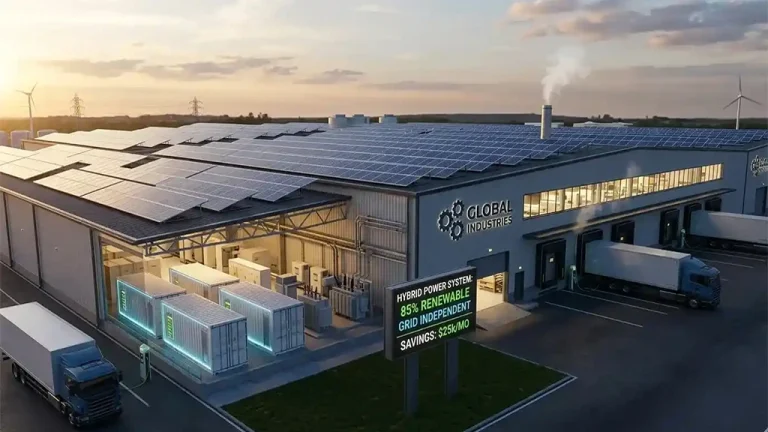
In today’s competitive industrial landscape, operational efficiency, cost control, and sustainability are not just business goals; they are imperatives. For industrial companies, a reliable and cost-effective energy supply is the lifeblood of their operations. Even minor disruptions can lead to significant financial losses, while volatile energy prices can erode profitability. This is where hybrid solar systems emerge as a transformative solution, offering a powerful blend of energy independence, cost savings, and environmental responsibility. A hybrid solar system integrates solar photovoltaic (PV) panels with a battery energy storage system (BESS) while remaining connected to the traditional utility grid. This three-pronged approach allows industrial facilities to generate their own clean energy, store it for later use, and still draw from the grid when necessary. The result is an optimized energy strategy that addresses the most critical challenges faced by the industrial sector.
The Unwavering Demand for Uninterrupted Power
Modern industrial operations rely on sophisticated, sensitive machinery, ranging from CNC machines and robotic assembly lines to data centers and chemical reactors. For these critical systems, even a momentary power outage can trigger costly shutdowns, production delays, and equipment damage. While traditional on-grid solar systems must shut down during a grid failure for safety reasons, hybrid systems seamlessly switch to battery power, providing an uninterruptible power supply (UPS) that keeps operations running smoothly. This enhanced reliability is arguably the most significant advantage for any industrial company where downtime is not an option.
Taming Volatility: Cost Control and Energy Independence
Energy costs represent a substantial operational expenditure for most industrial businesses. Utility tariffs for industrial users are often complex, featuring not only charges for the electricity consumed but also hefty demand charges based on peak consumption. Hybrid solar systems offer a strategic solution to mitigate these costs. By storing excess solar energy in batteries, companies can engage in peak shaving, drawing from their stored energy during periods of high demand and thus reducing their reliance on expensive grid power during peak hours. This not only lowers monthly electricity bills but also provides a hedge against future energy price volatility, fostering greater energy independence.
A Greener Footprint: Sustainability and Corporate Responsibility
In an era of increasing environmental awareness and stringent regulations, industrial companies are under pressure to reduce their carbon footprint and demonstrate a commitment to sustainability. Hybrid solar systems directly contribute to these goals by significantly reducing Scope 2 emissions (indirect emissions from purchased electricity). By generating on-site clean, renewable energy, industrial facilities can meet international sustainability standards, enhance their corporate social responsibility (CSR) profile, and attract environmentally conscious investors and customers. This commitment to green energy can also unlock various government incentives and tax benefits, further improving the financial viability of such investments.
Scalability and Future-Proofing
Industrial growth often entails increasing energy demands. Hybrid solar systems are inherently scalable, allowing companies to start with a system that meets their current needs and expand it modularly as their operations grow. This flexibility ensures that the energy infrastructure can evolve with the business, optimizing capital expenditure and avoiding the need for complete overhauls. Furthermore, integrating battery storage makes these systems future-proof, enabling them to adapt to advancements in energy management technologies and potential changes in grid regulations.